Transformation is an exercise, and it's time to get in shape.
Something strange happened last Saturday. I wanted breakfast. Simple, quiet, just for me with whatever I had in the kitchen. And then — without fully noticing — I made hummus, a topping for the hummus, a tomato sauce I let cook for two hours, a chickpea stew, and a stuffed roasted courgette. When I finally stopped I thought: I only wanted breakfast. Kitchen was already clean. Breakfast at the table. The rest of the stuff cooling down.
What have I done?
The retreat had possessed me — and I hadn't even noticed.
Let me explain what happens to a body — and a mind — when it has been cooking for others for several days. But first, some context.
The last five months of 2026 I have been doing things quietly. Writing a lot. Finishing some client consultations, trying to initiate others. Pitching articles to magazines I love — nothing confirmed yet, just trying. Playing with tools I first imagined, then tested, then failed with. Collaborating on different projects to play with my own personal prototype — my new self — nothing fully defined yet, no matter how much time has been invested. And yes, doing some food stuff too.
There is a difference between what your mind tells you you can do and what your body is quietly asking you to reconsider. I have learned — slowly, reluctantly, and then gratefully — that when the body speaks loudly, the most useful thing you can do is listen. Not to give up. To question. What am I doing? How am I doing it? And for whom?
The autoimmune conditions are not me. But they are my new context.
And context is not a limitation. It is a new place where everything emerges — with new environmental characteristics to take into consideration. As part of a game I did not choose to start but have decided to play consciously.
So when I decided to cook for this retreat — one last time, in one of the most beautiful places I know — it was not in spite of all of this. It was because of it. A new context demands a new question. And mine was: what do I want to take with me? And what am I ready to leave behind?
So as a celebration of this transition — which began properly last year — I decided to do one last food-action job. Here is a short reflection about the possibilities. In my case, after ten years working in cooking for health and wellness oriented businesses, there were a few roads to take:
Working full time for a restaurant. Working as a freelancer for retreats and catering. Becoming a teacher — a difficult path to access when you belong to what I call the Vocation-First Wellness Industry: the founders, cooks, and creators who built from conviction before wellness became a category — who followed their own rules before there were rules to follow. Driven by health, by values, by a need to do things differently. Not a niche. A movement. And they are still there, still building, now spreading into other industries far beyond hospitality. My nomadic spirit and tendency to cross disciplines made the traditional credential structures hard to fit.
And then there is what I really love to do: help people create business ideas that go far beyond labels — understanding those labels as functional characteristics of an idea, not the idea itself. Working on the transformation you want to bring into action in the context where your idea belongs.
Cooking for a retreat was another way of feeling the information from the inside. In this place, the third time:
The first time: completely alone, figuring everything out by myself.
The second time: a job test, proving myself to others.
The third time: proving something to myself. A proper goodbye — with a high note.
In my case, the information I need to process always comes through experience — felt in my own body first.
Madness. He! What a bad idea.
Sisters,
We have to find a way to get on top of hurting,
the way we take our pain and make a church of it...
— Joshua Idehen, Brother, from his 2026 album I Know You're Hurting, Everyone Is Hurting, Everyone Is Trying, You Have Got To Try. Brother, I hear you.For as long as I can remember I have been an assistant. In my first life — an artist's assistant. In my second — a chef's assistant. And at this moment, right now — my own assistant.
Being an assistant taught me to see what others cannot see yet. To imagine what is going to happen before it happens. To have 360 degree eyes. To create the space for others to thrive — quietly, invisibly, without needing to be the one in the centre.
Being my own assistant is harder. Especially these days, when I am both the one who plans and the one who executes. The one who writes the instructions and the one who follows them. The one who creates the space — and the one who has to show up and fill it.
And I love doing it for others too — when they ask, and when they deserve it. Deserving it, for me, means recognising the role. Recognition works both ways. What I value most is honesty, transparency, and coherence. Without those, the assistance becomes invisible in the wrong way.
Two weeks before the retreat I become my own past self — writing menus, editing, calculating ingredient costs per person, building prep lists and shopping lists, worrying about what might go missing or fail, adding a small extra challenge here and there because I cannot help myself. All of this so that the version of me who arrives tired and full of adrenaline on day one has everything she needs. A structure to follow. Or to ignore, if intuition pulls me somewhere else. Both are valid.
The structure exists so the flow is possible — even when reality decides to take me in a different direction.
And then the week itself. One day to pack. Six retreat days. Fourteen hours straight every day.
My 47th birthday just around the corner, my body already feeling the damage — but my mind sharp. Apart from the emotions making everything a little blurry. But still sharp. He.
"...Call it coping, call it worship."
— Joshua Idehen, Brother, Don't Let It Get You Down, from I Know You're Hurting, Everyone Is Hurting, Everyone Is Trying, You Have Got To Try (2026).Now let me tell you what happened inside those six days. Not the menu. Not the dishes. The things behind — the invisible machinery, the mistakes, the learnings. The stuff that nobody sees but that makes everything possible or impossible.
I should warn you: I get into flow easily. Dangerously easily. Like soft ice cream slowly pulling down over a cookie cone — impossible to resist, impossible to stop. You just watch it happen and surrender. That is why I don't have any pictures to show you. Just believe me — this is what happens. Not a strategic decision. But I still believe that cooking is a relationship: between you, the environment you cook in, and the people you serve.
I honour this relationship, this moment we share — no matter how good or how bad it is.
I value the present moment. There is no time to think about later promotion or whatever.
Someone told me during the retreat:
Carolina, you need to be more present. Try a breathing technique — the 4-7-8 method. Inhale for 4 counts, hold for 7, exhale for 8. Stay calm.
I thought about it.
[Stay cool, learn to swim
Nah, mate, you're not too heavy…]
— Joshua Idehen, from Learn To Swim, A Mixtape (2023)Really thought about it.
I disagree.
Only people who have cooked for more than ten people for more than one day will agree with me.
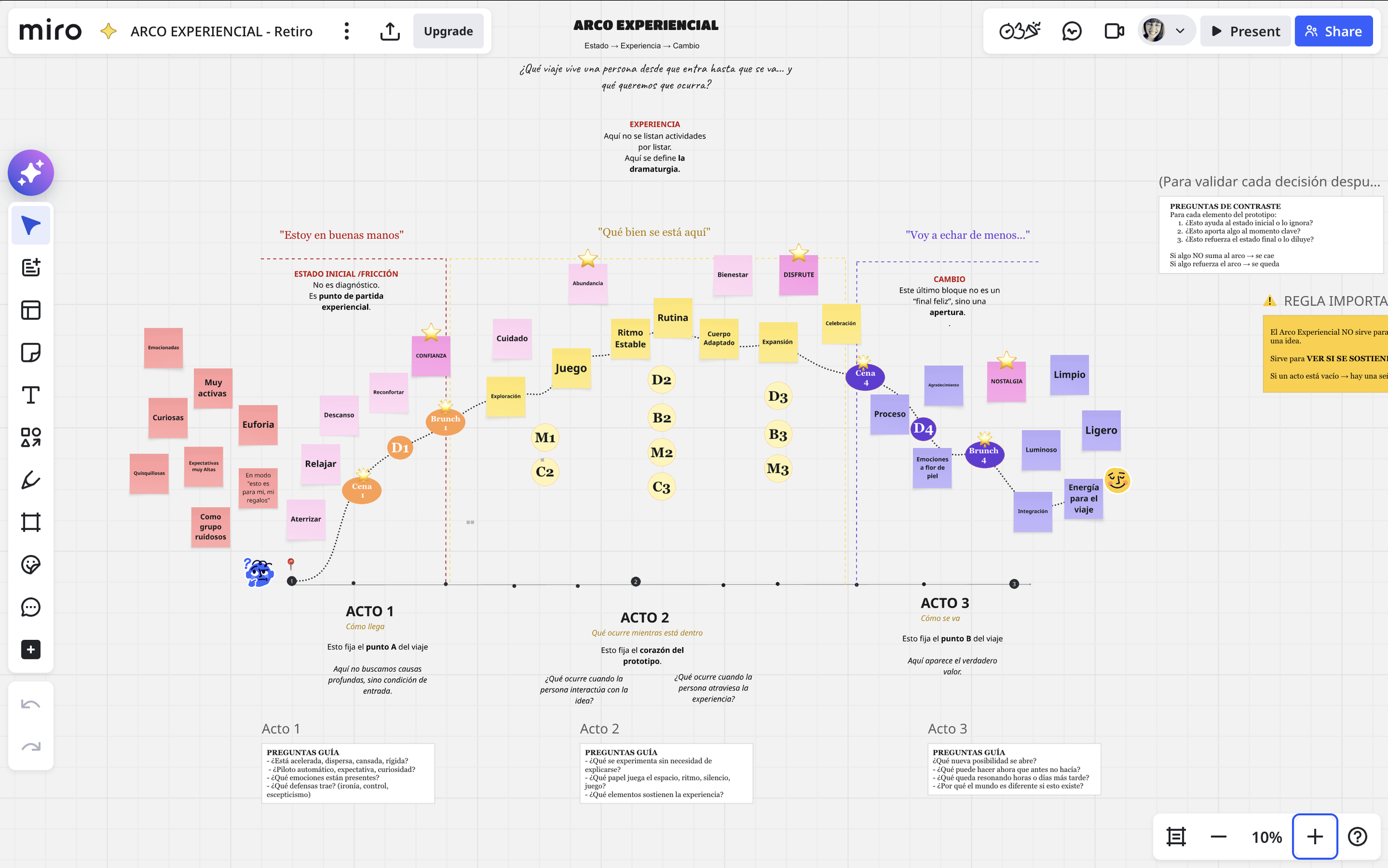
Before I decided the menu, I designed the experience:
State → Experience → Change.
How do I want them to arrive? How do I want them to leave?
Design the feeling before you design the thing. The dishes came after. This is a tool I have been developing — The Arc. I will share it with you soon.
What you do in a kitchen is not about being present.
It is about presencing.
If this is the first time you have heard or read that word — take your notebook and write it down. Presencing is a blended term: presence + sensing. It means connecting with and acting from your highest future potential, rather than repeating patterns from the past. Developed by C. Otto Scharmer in Theory U, it involves deep listening and awareness — bringing emerging future possibilities into the present moment.
And that is exactly what cooks do.
It is not metaphorical. It is a fact. Or at least — it is what we try to do.
What you do in a kitchen is not about being present. It is about presencing.
My personal stories are just the starting point. The excuse to open a conversation about something bigger. What follows are not just learnings from a kitchen — they are practices you can apply anywhere.
Learning 1: Presencing
Presencing (*) in a kitchen means reading what is happening right now and responding from your best possible self — not from habit, not from fear, not from yesterday's mistake. It involves a shift in consciousness: from ego-centric — focused on yourself — to eco-centric — focused on the whole system.
It sounds simple. It is one of the hardest things I know.
But the practice belongs everywhere. In a meeting. In a conversation. In a creative project. Anywhere you need to respond to what is actually happening — not to what you expected to happen.
Learning 2: “Hindsight-Spotting”
Inspired by the practice of trendspotting — the art of identifying emerging shifts before they become impossible to ignore — hindsight-spotting is something I have developed for myself as a proactive process of noticing what is changing in your performance, in the people around you, and in the environment you are working in — before it becomes impossible to change or switch direction.
But here is the key: do not do it during the work days. Not even immediately after you finish. Wait. Give yourself a couple of days. Let the dust settle, let the body recover, let the emotions find their place — the right one, especially if you are an emotional animal like me.
And when you do it — do not focus only on what went wrong or what you could have done better. Go macro. Ask yourself:
What are the bigger patterns here?
What can I carry into the next thing I do — not just the next kitchen, but the next project, the next collaboration, the next version of myself?
Always leave everything better than you found it.
The kitchen. The room. The conversation. The relationship. Everything.
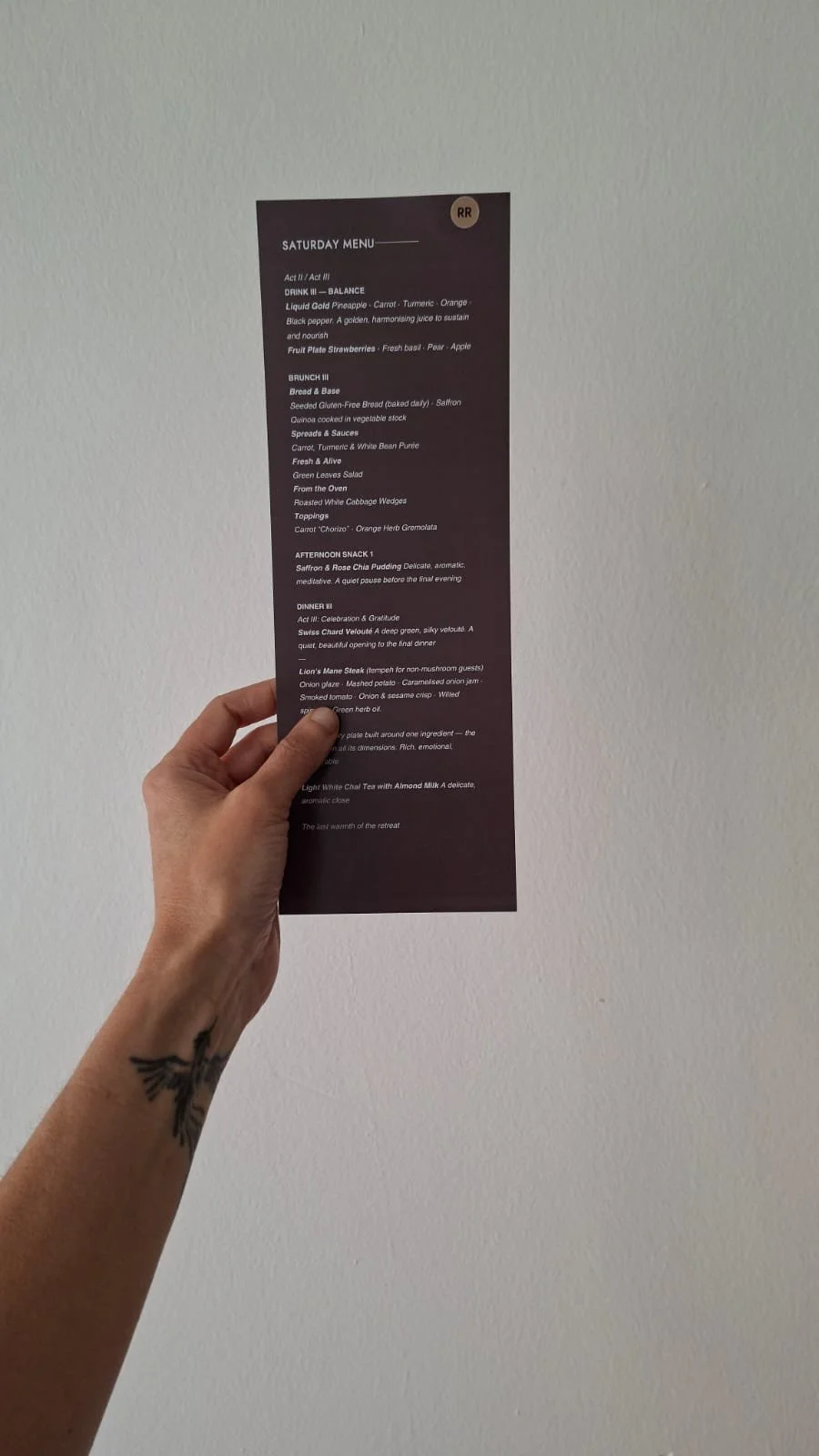
The only material proof I was there. A printed menu — given to me by the retreat host to double check every detail before each day began.
95 — 90 — 70:
95% of what I planned happened exactly as designed. 5% were changes I made in real time to adapt to the rhythm of the days.
90% of the timetable was respected. The 10% delay? Never more than five to fifteen minutes. In a retreat kitchen, that is called presencing.
70% of the menu went exactly as planned. The other 30% — unexpected things. The kind you cannot predict, cannot prepare for, and cannot control. The kind that teach you the most.
What I nailed: the desserts. Not at the end of dinner — I replaced them with a special hot drink designed for each evening, following the arc of the day. And every afternoon, around 4pm, a small sweet bite. A quiet reward. Enough space to digest. Enough sweetness to keep going.
Hidden learning: the small details, done right, at the right moment — those are the things that make you shine. Not the grand gestures. The tiny ones.
Learning 3: Feedback
In every connection we have, in every job we do — or in anything we buy or experience — there is a moment where you will have to decide to give feedback, or you will have to answer or react to feedback you receive.
And most of the time — on both sides — we get it wrong. We say the right thing at the wrong moment. Or the wrong thing at the right moment. Or we say nothing at all, which is its own kind of failure. And the same when we receive it.
Giving and Receiving feedback is one of the most underestimated skills there is. Not because it is complicated — but because it requires something most of us are still practising: the ability to separate what we observe from what we feel, and what we feel from what we project.
Feedback is precious. But only when three things are considered:
What you say.
Who you say it to.
And when you say it.
And what is feedback supposed to do?
My very best friend Shiva said it better than I ever could:
Feedback is a gift. When given correctly, it is a two-way investment. The recipient gains insights to improve — and the giver learns how to communicate and lead better.
Both people grow. Or neither do.
And before the words leave your mouth — give yourself two seconds. Ask yourself honestly: am I saying this because I truly believe it will help? Or am I using this person as a mirror for something I have not yet resolved in myself?
That question, by the way, is the shift from ego-centric to eco-centric that we talked about in Learning 1. It keeps coming back.
Because it is the thread connecting everything.
This is not a goodbye. It is a see you differently — later, from another angle, with different hands. I will miss everything and nothing. Which means I am ready.
What I will miss most is the flow. Not just the flow of cooking — but the energy that emerges when you are fully inside the doing. And the other kind of flow: the one that appears when you build something alongside another person. The companionship of a shared kitchen. The electricity of two people moving toward the same thing without needing to explain it.
And the learning curve. The way repetition accelerates growth. The faster you move when you have done something a hundred times and your body knows before your mind does.
But I have learned something about myself: I can help more when I spend time designing than when I spend time doing. The doing taught me everything I know about designing. And now it is time to use it.
I chose this. Not despite everything — because of everything. Because sometimes the most honest thing you can do is show up one last time — fully, completely, without holding anything back — and then turn around and start building something new.
This is my love letter to retreats. And also proof — for you and for me — that you can extract a learning from any situation. That any experience, lived consciously, becomes information. Becomes material.
Theater director Peter Brook described the ideal design as one with "clarity without rigidity" — open, never shut, always in motion, always in relation to what is actually unfolding, flexible. If we see the kitchen as Peter Brook sees the theatre (The Empty Space, 1968), a beautiful metaphor emerges. We do not need an elaborate scenery. We only need three things:
A space — no matter how plain.
An actor — a cook, a maker, a presence — someone performing an action.
An audience.
The conscious empty space is a blank canvas where the imagination of the spectator and the presence of the actor create reality together. Unique every moment. By removing what is not essential and keeping what really matters, the audience focuses entirely on the human experience — and the invisible world of emotions and spirit.
That is what a theatre teaches you. That is what a retreat teaches you. That is what transformation teaches you.
Design with clarity. Stay open. Let reality in.
Presencing. Hindsight-spotting. Feedback. Three exercises. Three practices. Three things a kitchen taught me that have nothing to do with food and everything to do with how we show up — in our work, in our relationships, in our own evolution.
Transformation is not a moment. It is a practice. And like any practice — it requires showing up, making mistakes, and continuing anyway.
Joshua Idehen said it better than I can:
…This life will teach you lesson after lesson
And they will not all be gentle or soft spoken
I don't care how corny it sounds
You are not alone in this town
I said I don't care how corny it sounds
You and I are deserving of good things
Good things are coming for you
And they are going to hurt
(Stomach tight, ready, pressing down)...
— Joshua Idehen, Don't Let It Get You Down, from I Know You're Hurting, Everyone Is Hurting, Everyone Is Trying, You Have Got To Try (2026)
One last thing — and no picture for this one. Just a thought.
After the retreat was over, the thoughts came. All the things I did wrong. All the ideas I should have had before. All the dishes I would change, refine, do differently next time.
But here is what I have learned to do with those thoughts: observe them. Not judge them. Not perform them. Just watch.
Because those are not failures. They are the raw material of growth. The adjustment. The next version.
Jacob Grinberg wrote in his book Fluir en el Sin Yo:
Learning about oneself means having the capacity to observe oneself and to deduce, from observation, the state in which we function and what we need to correct. To be able to observe our inner self, the fundamental tool is concentration.
That is hindsight-spotting. That is presencing. That is feedback — given to yourself, by yourself, with care.
Three exercises. One practice. Infinite iterations.
Gracias por ser parte de esta cocina en construcción. Let's keep building, playing, and nourishing — together.
Keep the creative fire going 🔥
Support My Work
If this helped you, consider sharing it with a friend, subscribing to my newsletter, or buying me a coffee. This space is a labor of love—and your support helps me keep building it.