It’s Never Just the Thing Itself
I started writing about frameworks. I ended up at the soil. A reflection on makers vs. consumers, the attention economy, systemic gastronomy, and the question I keep asking myself — without knowing the answer yet..
Still iterating. Still learning.
In the last newsletter I introduced 2 frameworks I have been — and still am — working on (a never-ending task, since I've only tried each of them twice and I know I need to keep iterating):
The Arc and The Onion Models.
Both frameworks operate on different levels.
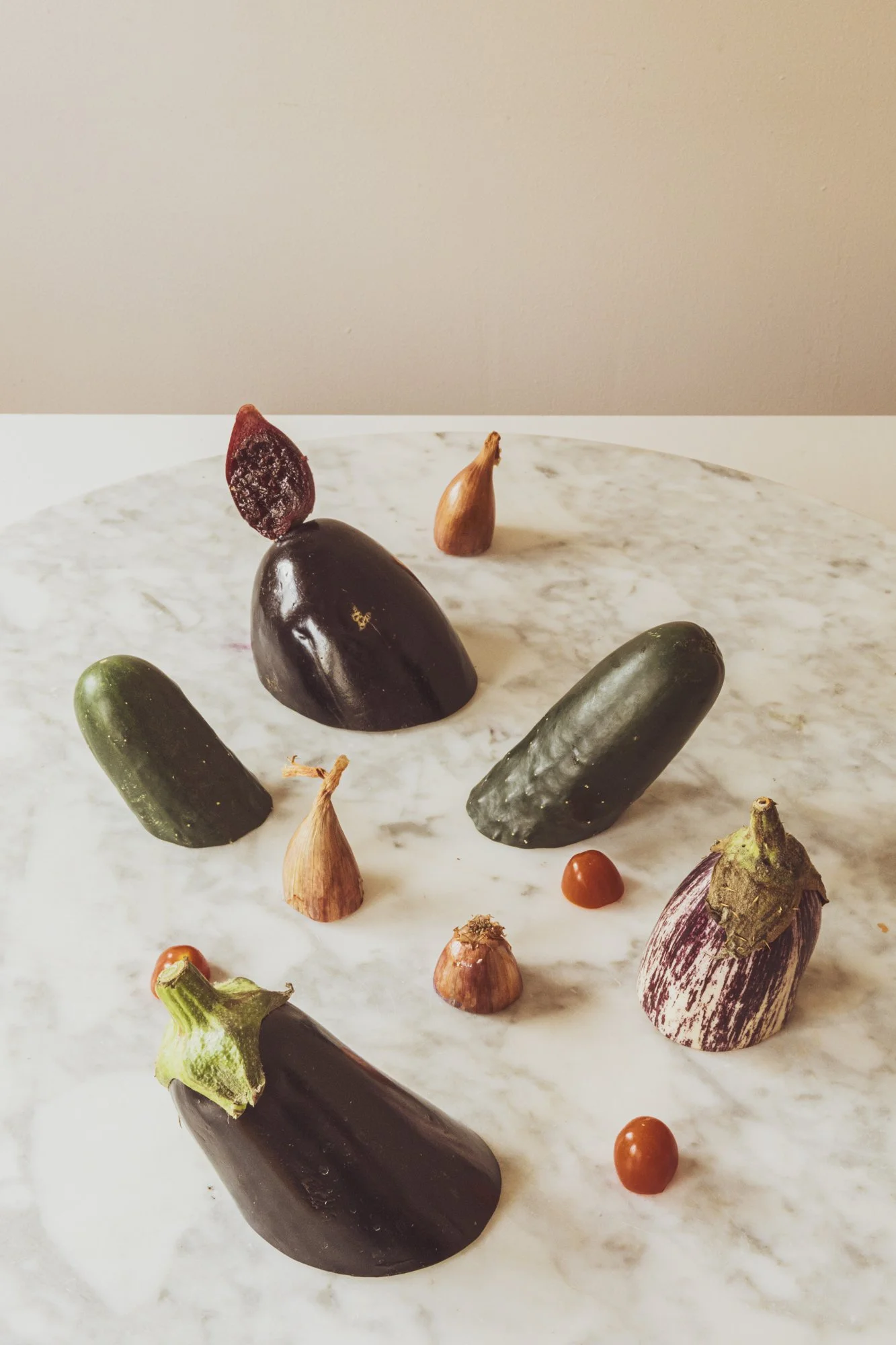
Knifes cuts. Personal Project 2024 (Tenerife)
The Arc is about designing the transformational journey of your clients first — or at least creating space to think about how they arrive and how you want them to feel after experiencing whatever you are building. First Experience — the emotional layer — is what we created to serve this purpose.
The Onion Model, on the other hand, takes you from your inner core outward to the external layers of your project idea. It helps you analyse where you are right now, and it can also be combined with other people's projects to explore where you can contribute rather than compete.
Sharing The Arc gave me the opportunity — or rather, an invitation — to present this framework in a real setting with people from other industries. (Muchas gracias, Patri, por la invitación, sé que está pendiente de confirmación pero … ;D ) That excited me, because I love learning by doing. At the same time, every new challenge brings with it a weight of responsibility that I feel very personally — that's just how I've been navigating this journey emotionally.
The Onion Model I got to try for the first time just a few days ago, in a discovery call with two amazing people who are thinking about bringing their two passions together to build something new. The call didn't go as I expected. I felt I wasn't ready — and honestly, neither was the framework. I am iterating myself too, and because I am not a product, I feel every single "mistake" on my own skin.
I know the coming months are going to be quite harsh. But I keep reminding myself: I am in the prototyping phase. I will come out stronger. I just need to find a way through these difficulties with a fresh perspective — trying to apply a little Einstein philosophy.

“Honor thy error as a hidden intention” – is a famous, foundational prompt from Oblique Strategies, a 1975 deck of cards created by Brian Eno and Peter Schmidt to break creative blocks. It encourages treating accidental mistakes, glitches, or unexpected, "wrong" outcomes as intentional artistic decisions that reveal a deeper, perhaps subconscious, creative direction.
A different level of consciousness.
Here's the quote I've been sitting with:
"No problem can be solved from the same level of consciousness that created it."
(Not to be confused with "In the middle of difficulty lies opportunity" — also useful, but not quite what I'm going for here 😄)
What this means to me, practically: shift your mindset — avoid autopilot. Change the paradigm. If a problem was born in a specific context, the solution often requires looking beyond that context. And quite often, what matters most is not finding the answer, but spending time formulating better questions.
I think these ideas summarise why I invest time exploring new ways to approach what I find difficult. Some of you might think I'm making things more complicated than they need to be — but what I'm really doing is keeping my curiosity alive during hard times.
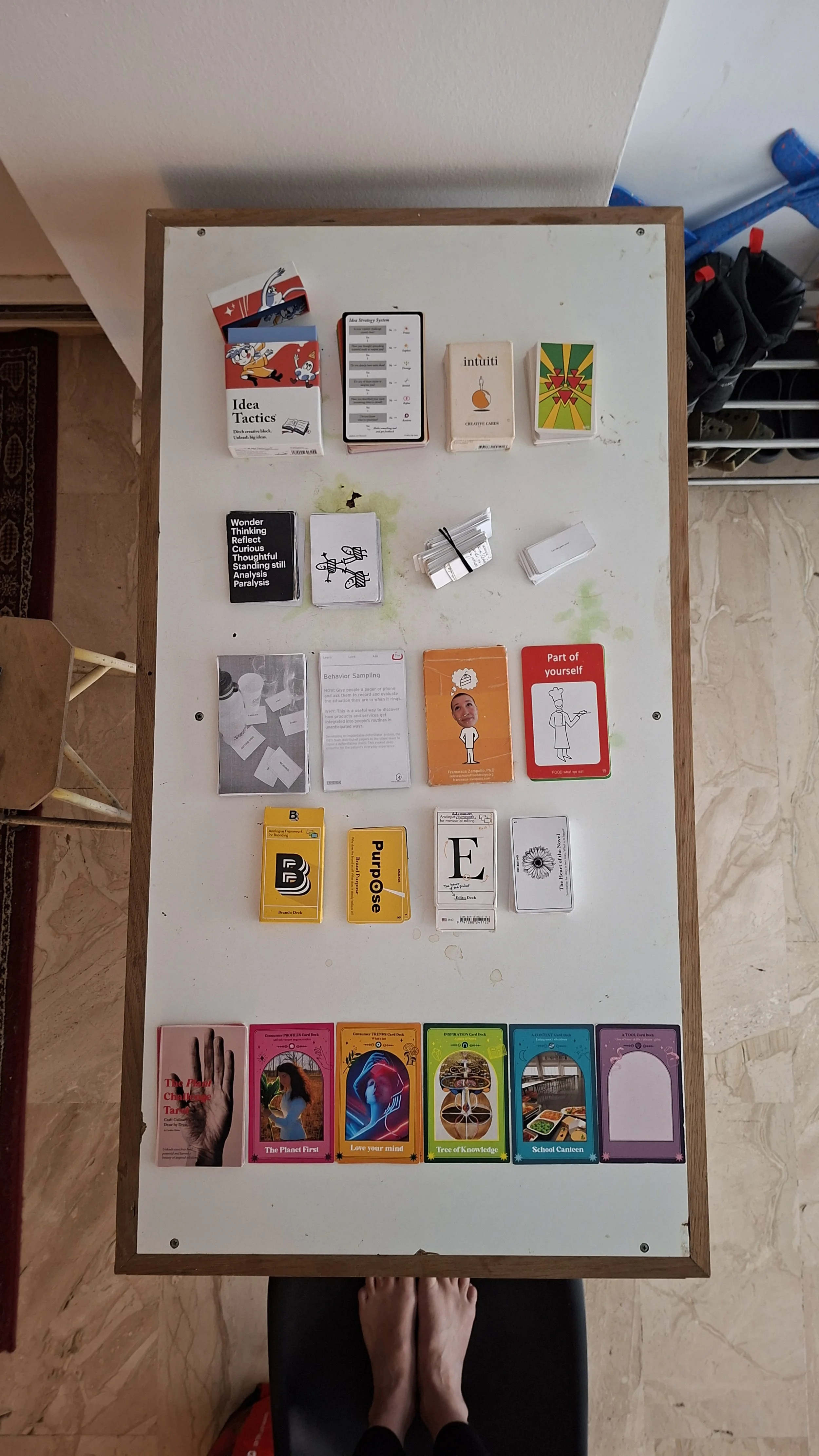
My tarot cards and a small selection of what I use to strengthen my tools (or just to play with myself).
Tiny ripples
Another reason why I love doing things this way is to try — even in the most micro way — to do them differently. My influence is small. But that small influence reaches my circle, and from there it reaches their circles too. Tiny ripples.
There are 2 types of people these days: those who only consume — often without even noticing — and makers. I want to be a maker. But not to make other people consume me. I want you to participate in this conversation. Not in person, but at least in your mind. I want you to read. I want you to think.
To be a maker.
And makers are not the people who share their lives on Social Media.
Makers are the people who build structures to make this world BETTER.
Ten years ago I felt stronger. How?
Ten years ago, with less knowledge than I have today, I felt stronger and more confident than I do now. How is that possible?
My self-esteem right now is really low. (Yes, I know — every newsletter becomes an excuse to share how I feel. But I'm not doing this as part of some storytelling strategy. This is raw vulnerability. No tears. No drama. Not performed in front of a screen. This is between me and you.)
So — what is the main difference between the me of today and the me of ten years ago? What sits in between?
My phone → The so-called smart one.
The molecule behind the scroll
Always connected, always available, always watching. What happens in our brains that makes us compulsively check our apps?
Behind that behaviour is a single molecule: dopamine — which the tech industry has learned to use with extraordinary precision to capture our attention and keep us coming back. Technology has become an inseparable part of society, more so every single day. It is everywhere, doing everything — including, increasingly, the creative parts of ourselves.
I am not against technology. I am just more aware of how it makes me feel.
Marshall McLuhan (1967) described technology as an extension of our bodies and nervous systems — effectively becoming part of the self. But this raises serious questions about our physiological and mental development, and surfaces a long list of ethical concerns.
Have you ever heard the term captology? It was coined by Stanford Professor B.J. Fogg in his book Persuasive Technology: Using Computers to Change What We Think and Do (2003). Fogg describes captology as the study of how computers and digital technologies persuade people to change their attitudes or behaviours. In simpler terms: a way to identify and target behaviours in the design of technology, where "engagement" may happen either willingly — or completely without the user's awareness.
When people begin to rely on a technology without realising it, persuasive technology has done its job.
Its influence goes unnoticed.
That's the point.
Do we really have to show up like this?
That is why I try to keep my mind busy — creating, doing, making
I know I probably need to show up more on social media, put myself out there in the ways the algorithm rewards. But that's not part of my core, at least not in the conventional sense.
Case in point: I have to record a reel for a course I'm running in May — a course I'm still developing, changing, adapting, turning over in my mind, trying to figure out how to make three hours genuinely useful. And honestly? The reel fills me with dread. I don't feel comfortable with that format. And I think we need to be more open to the idea that there are many ways to reach people, many ways to create real impact — without having to put yourself on display.
Why does everything feel like a meat market right now? Like you have to show up as a product, packaged and lit correctly, ready to be consumed?
Everything seems to have become a show.
What we do.
The war.
Travelling to the moon.
All of it — content.
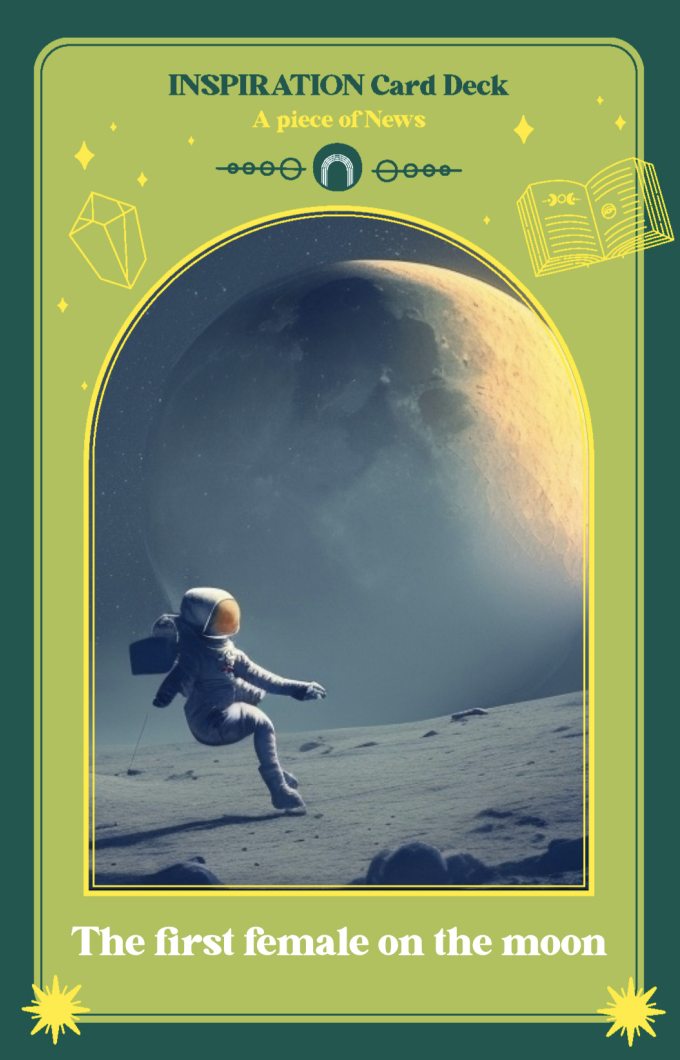
“The first female on the moon” - INSPIRATION Card Deck (The Plant Challenge Tarot Cards)
Everything has become a show
Today I heard there are two (main) reasons why we need to go back to the Moon.
First, because a trip to Mars can't be launched from Earth directly. And second — and this is where it gets interesting — space races are wars. Without claiming to be an expert, the US currently has two open fronts: an aerospace race with China, and a broader conflict involving almost half the world. Since the funds for the space race come from the same budgets as the military, the Moon landing has quietly become a live broadcast — a show designed to convince American society that those funds are necessary.
(OMG. What am I writing today? I can hear you thinking it. But bear with me.)
The point isn't the Moon. The point is this:
No matter how good you are, no matter how much experience you have — ask the astronauts — at some point you are asked to play the role of entertainment.
And the work I admire most right now is exactly the opposite of that. The projects and people I find most nourishing are the ones that make you reflect. The ones that hand you back something you thought you understood and say:
are you sure?
Where do you want your work to belong?
So I want to ask you something. Where do you want your work — whatever it is you do — to belong?
a) Entertainment.
b) Connecting what we've been taught to keep separate — nature, community and inner life.
c) Challenging the stories we tell ourselves about how things have to be.
d) Questioning the systems we inherited without choosing them.
e) Other.
No wrong answers. But I'd love to know.
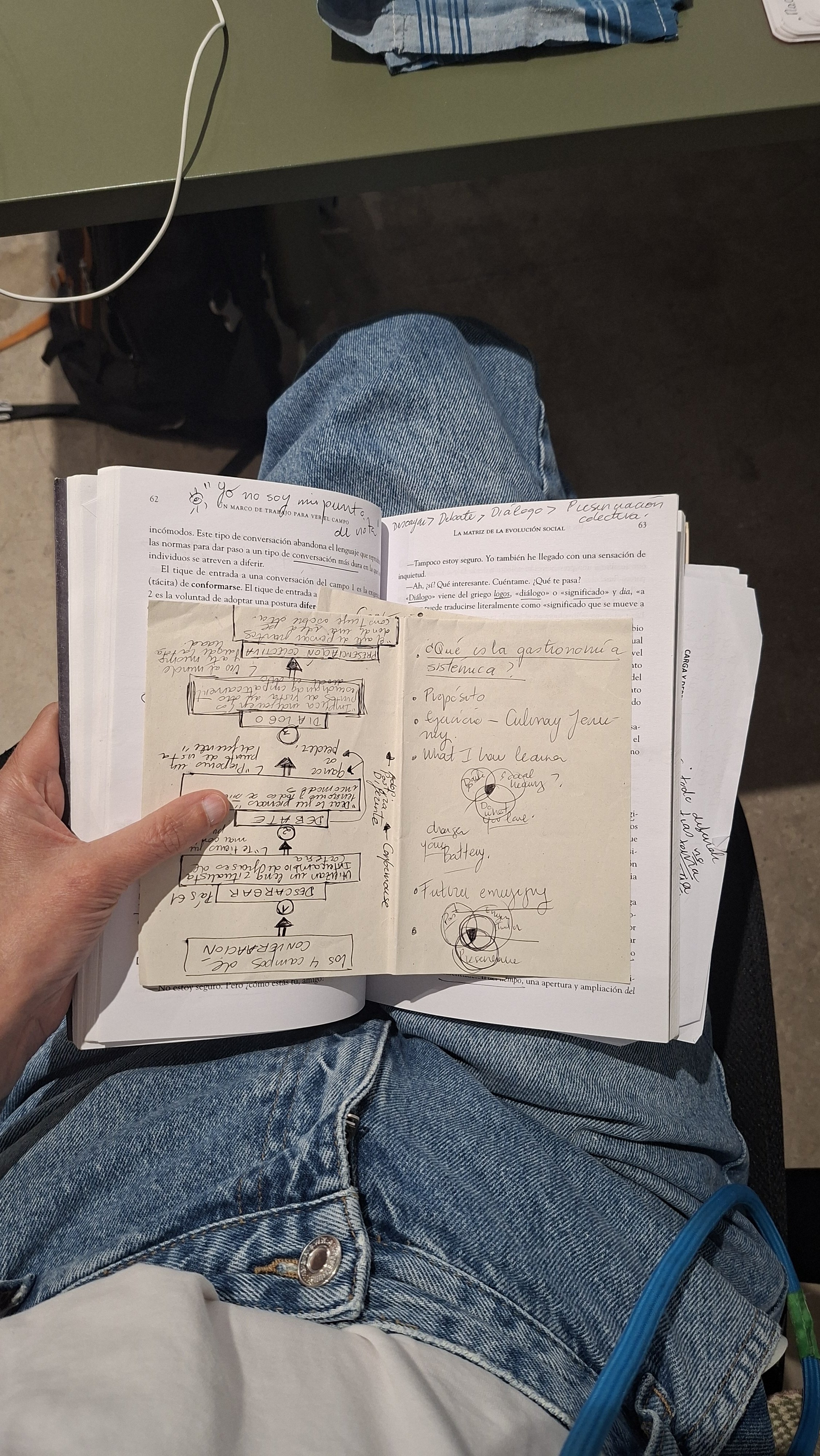
¿Qué es la gastronomía sistémica?
A random note. A name. A question.
I always have random notes around me. I hear something I want to explore but don't have time to stop for in that moment, so I write it down on a piece of paper and leave it for later.
Yesterday I found one that feels worth sharing today:
What is systemic gastronomy?
I came across the name Juan Ignacio Gerardi and something made me stop. He said something that we can apply far beyond the kitchen:
"Demanding that the soil give us everything in every harvest, without thinking about its recovery, slowly leads it to a point of no return."
For Gerardi, regenerative agriculture is not just a production technique — it is part of a broader cultural shift. "Before, we ate enough. Today, we eat and then supplement our diets. That also speaks to the state of the soil." In a world that is changing its consumption habits and production methods, agriculture cannot remain on the sidelines. We are facing a paradigm shift. And like all change, it brings an opportunity: the opportunity to do things better.
How can we start doing things better?
By first listening — and reading — better, and then moving towards having better conversations.
C. Otto Scharmer describes four levels of conversation.
The first is Downloading — where we simply exchange courtesy, saying what is expected.
The second is Debate — where we speak to win or lose, not to understand.
The third is Dialogue — where instead of trying to dismantle the other person's point of view, we approach it with curiosity and empathy.
And the fourth, my favourite: Generative Dialogue — the art of thinking together, where one idea builds on another, and something new emerges that neither person could have reached alone.
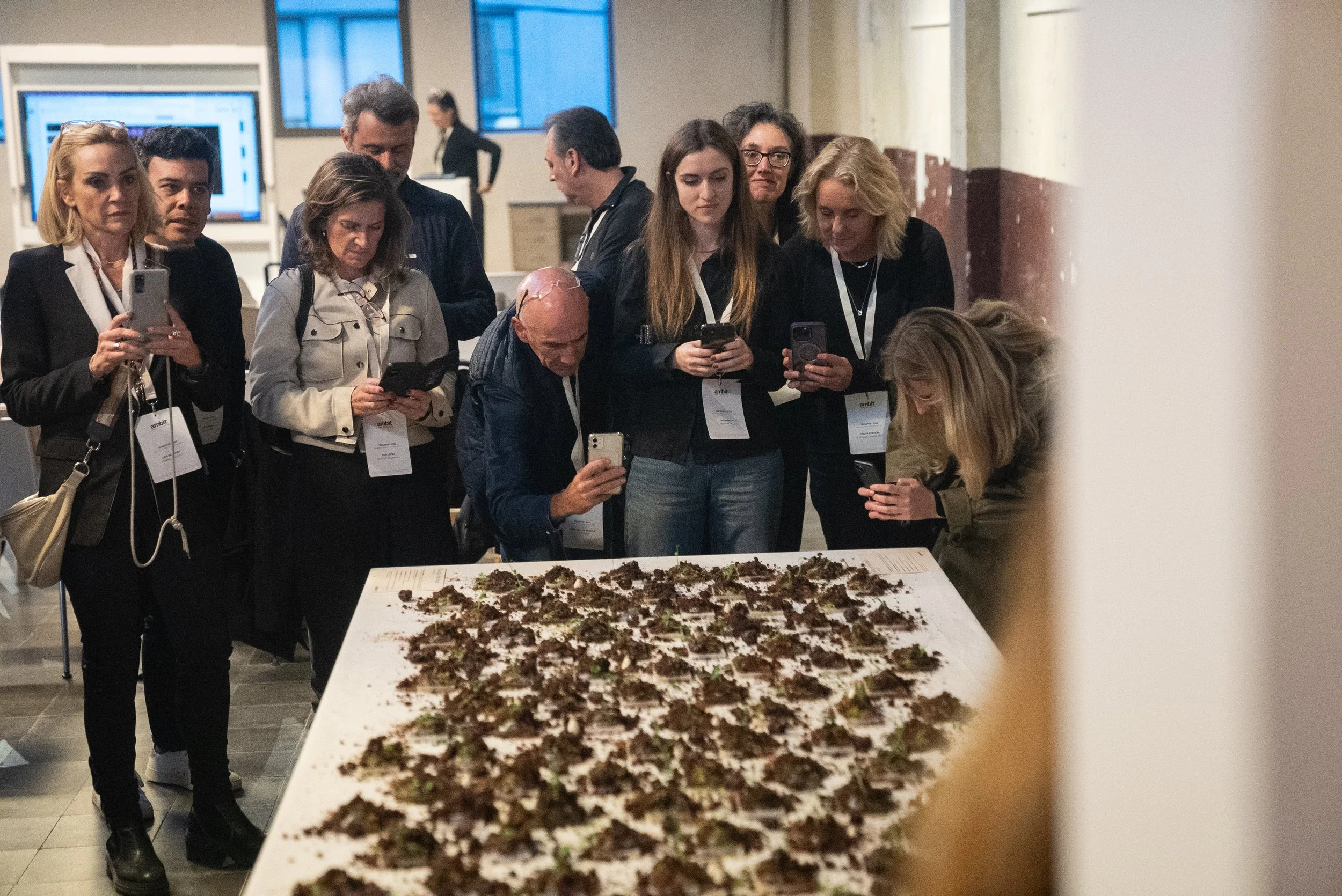
Taking in the Forest. TrendFEST 2023 (Barcelona)
It's always about what surrounds it
Because what I understand — or at least what I sense — is that systemic gastronomy doesn't look at food as fuel.
It doesn't look at food as entertainment, or as content, or as something that belongs to one person, one chef, one plate. It looks at the whole context. The systems around food. The structures that decide what gets grown, who gets to eat it, and what meaning we give it — and that, my friends, is something that demands better conversations from all of us.
And I think this is exactly where this newsletter was heading all along — without me fully knowing it when I started writing.
Food, like your work, like technology, like a trip to the Moon, is never just about the thing itself.
It's always about what surrounds it.
More on this next time.
My dream: to be genuinely connected to the present moment, and to contribute to making things better. How? I am still figuring that out — not knowing how, not even where. But I think it is worth at least keeping asking myself that.
Support My Work
If this helped you, consider sharing it with a friend, subscribing to my newsletter, or buying me a coffee. This space is a labor of love—and your support helps me keep building it.